Tetration, Zeration
For positive integers,
Multiplication is the same as repeated addition.
Exponentiation is the same as repeated multiplication.
There are two ways to go with this: what is repeated exponentiation? and what, repeated, is addition?
Repeated exponentiation is known as tetration.
The step below addition might be the increment operator (adding one.) Another possibility is called zeration. Both have some things going for them.
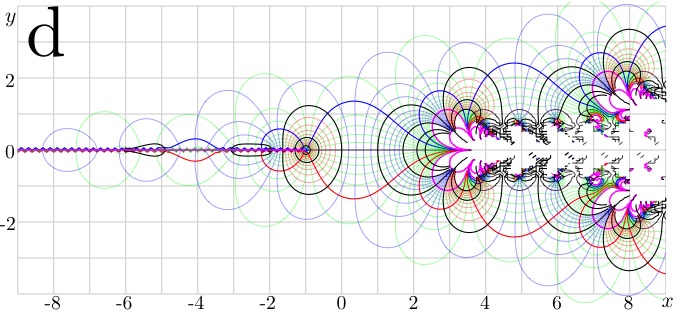
Any of these functions can be extended to work on real numbers. The picture is from the wikipedia article on tetration. I thought it was pretty.


Comments
If you pull back addition via exponentiation, you get multiplication.
a*b = b*a = exp(ln a + ln b)
If you pull that back, you get the Diffie-Hellman key exchange:
a#b = b#a = exp(ln a * ln b)
The process can be repeated indefinitely:
a$b = b$a = exp(ln a # ln b)
...
But you can also define an operator @ analogous to zeration by pushing forward addition:
a+b = b+a = exp(ln a @ ln b)
or
a @ b = ln(exp a + exp b)
It's related to the Zech logarithm:
zl(x) = ln(x+1)
since
ln(exp(a)+exp(b))
= ln((exp(a-b)+1) * exp(b))
= ln(exp(a-b)+1) + b
= zl(exp(a-b)) + b
= zl(exp(b-a)) + a by symmetry
You have written a homomorphism on the basis of the log of addition. It not Zeration which is defined under the classical scheme:
a o a o a o ... o a = a+b
repeat b
Though zeration is a nice companion to tetration.
-Rodney